3 Space Games to Boost Kids Memory
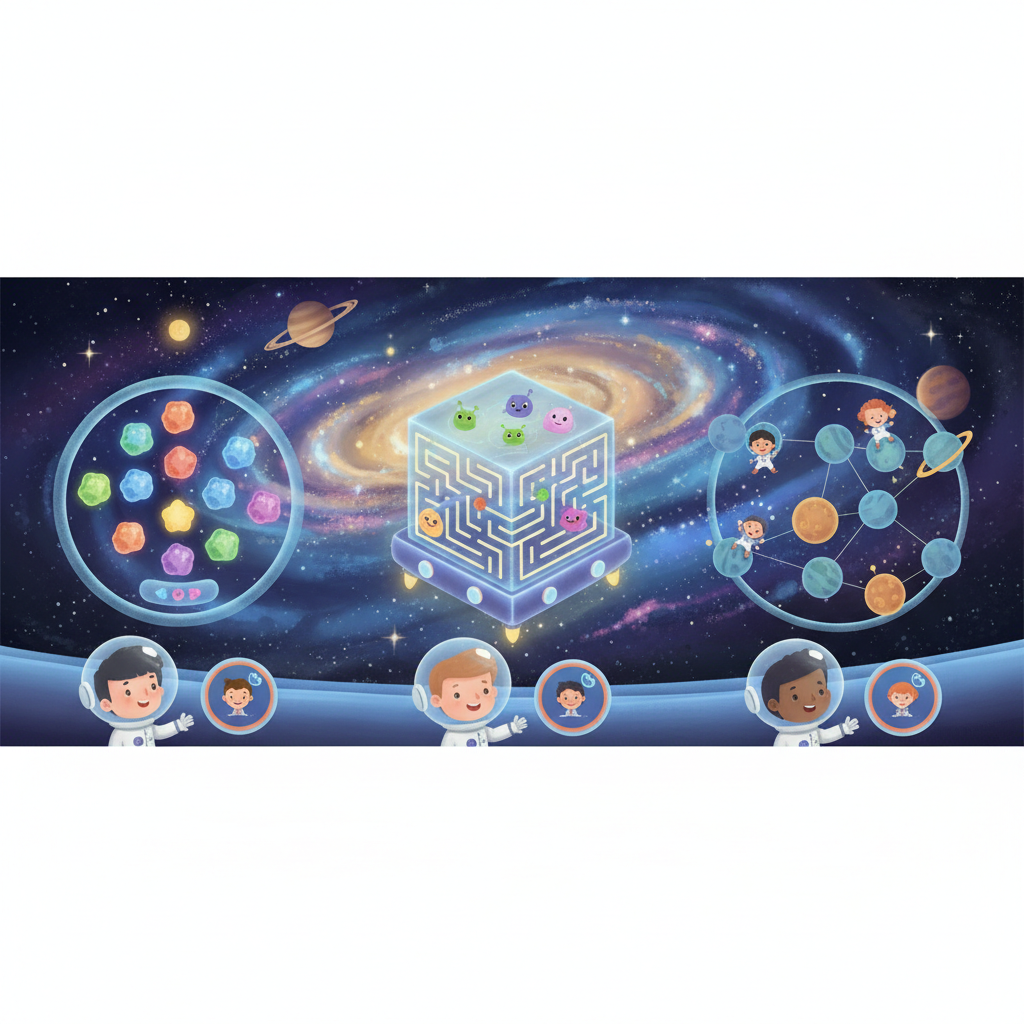
Imagine your living room floor transforming into the vast, shimmering expanse of the Andromeda Galaxy for an afternoon. Instead of fighting through another tedious flashcard session, your child is now a Commander preparing for a high-stakes deep-space rescue mission. By weaving cognitive training into an epic space adventure, we transform standard rote exercises into an engaging visual superpower.
This shift from simple memorization to immersive narrative is not just about having fun during playtime. It is about building critical neural pathways for lifelong focus and information retention. When we frame memory challenges as cosmic adventures, children engage more deeply with the material and develop lasting cognitive skills.
Why Narrative Enhances Visual Memory
Stories Help Information Stick Better
Science suggests that the human brain is naturally hardwired to remember stories rather than isolated, dry facts. When a child follows a narrative plot, their brain releases neurochemicals that signal the importance of the incoming information. This makes the details of the story much easier to recall later during school or other daily activities.
Visual recall is the specific ability to remember the characteristics and locations of objects in a three-dimensional space. Strengthening this skill allows children to better navigate their physical world and eventually excel in complex subjects like mathematics and reading. By practicing these skills in a playful environment, we remove the pressure often associated with learning.
According to research from the Harvard Center on the Developing Child, executive function skills like working memory are essential for long-term success. We can nurture these skills by providing environments that challenge the mind without causing stress or boredom. Stories provide the perfect low-pressure vessel for this kind of intense cognitive growth.
Integrating these exercises into your daily routine does not require a laboratory or a specialized degree. It simply requires a spark of imagination and a willingness to explore the stars together as a family. Every child has the potential to become a focus ninja if they are given the right tools and motivation.
Game One: The Nebula Navigators
Charting Your Path Through Stars
In this first mission, your child takes on the role of a lead navigator charting a course through the dangerous Nova Sector. You will need a set of colorful cards or household items to act as different planets and celestial bodies. The goal is for the navigator to memorize the positions of these objects before a 'nebula cloud' covers them.
Start by placing three items in a specific pattern on the table or floor while your child watches. Tell a story about why the 'Emerald Planet' must be to the left of the 'Ruby Star' to avoid a black hole. This narrative context provides a 'why' for the memory task, making it more significant to the child's brain.
After ten seconds, cover the items with a cloth and ask your child to replicate the pattern using their own set of objects. This simple act of reconstruction helps Boost 7-Year-Old Focus by Expanding Working Memory by forcing the brain to hold and manipulate visual data. As they improve, you can add more objects or more complex story elements to increase the challenge.
To make this even more engaging, use these items:
Benefits for Spatial Awareness
As the Nebula Navigators mission progresses, children start to notice finer details in the arrangements you create. This heightened awareness of spatial relationships is a key component of visual recall. They aren't just looking at things; they are observing how things relate to one another in a physical space.
Over time, this practice helps children visualize complex concepts in their heads without needing physical aids. This is a foundational skill for mental math and high-level reading comprehension. By turning the exercise into a game, we ensure the child remains in a 'flow state' where learning happens naturally.
Game Two: Lunar Locker Logic
Cracking the Cosmic Security Codes
For the second game, we move the action to a high-security lunar base where a 'Solar Flare' is about to hit. The child must memorize a sequence of 'security codes' to lock the base doors and protect the crew. These codes are actually sequences of colors, shapes, or sounds that you present in a specific order.
Instead of just showing symbols, give them a story-driven purpose, such as 'Blue for oxygen, Green for power, and Red for the shield.' This helps the child use associative memory to link a visual cue with a meaningful concept. It turns a boring sequence into a life-saving mission that requires absolute concentration and precision.
This specific game is excellent for helping to Train Kid's Impulse Control With Slow-Motion Missions because it requires waiting and careful observation. The child cannot rush the code; they must wait for the entire sequence to be revealed before they can act. This patience is a core pillar of deep focus and attention management.
Use these sequence types for variety:
Boosting Short-Term Retention
Lunar Locker Logic focuses heavily on short-term retention and the ability to ignore distractions during the encoding process. In a world full of digital noise, the ability to focus on a single sequence of information is a true superpower. This game trains the brain to filter out 'space debris' and focus on the mission at hand.
As children become masters of the lunar base, they often start creating their own codes for parents to solve. This role reversal is a powerful way to solidify their understanding of the memory process. It empowers them to take control of their own learning journey while keeping the atmosphere light and playful.
Game Three: Starlight Constellation Quest
Finding Patterns in the Void
Our final game focuses on pattern recognition, which is essential for identifying the Cosmic Treasure Map: 3 Story-Driven Memory Games for Children to Boost Visual Recall. In this mission, the child is an Intergalactic Scout looking for lost constellations in a field of random stars. You can use a piece of black paper with white dots or even a starry night sky if you are outdoors.
Trace a simple shape, like a triangle or a zigzag, between the dots and tell a story about the 'Great Dragon' or the 'Ancient Shield.' The child must then find that same 'constellation' in a different part of the star field or draw it from memory. This requires them to see the 'big picture' while also focusing on the individual points of light.
Pattern recognition is a sophisticated cognitive skill that helps children make sense of the world around them. According to Psychology Today, visual memory is deeply linked to our ability to categorize and understand our environment. This game encourages children to look for hidden order in what might initially seem like chaos.
Try these constellation themes:
Strengthening Long-Term Recall
While the first two games focus on immediate memory, the Constellation Quest can be used to build long-term recall. Ask your child to remember a specific constellation they 'discovered' yesterday and see if they can find it again today. This bridge between short-term and long-term memory is vital for academic success and personal organization.
When a child successfully recalls a pattern from a previous session, their confidence as a learner skyrockets. They begin to see themselves as someone who is 'good at remembering,' which is a self-fulfilling prophecy. This positive self-image is one of the greatest gifts a parent can give to a developing mind.
The Power of Narrative Play
Why Gamification Works for Focus
At Kobotutor, we believe that focus is a trainable skill, not an innate trait that children either have or do not have. Gamification works because it aligns with the brain's natural reward systems, making the hard work of concentration feel like a rewarding challenge. When children are 'playing,' they are often working harder than they ever would in a traditional classroom setting.
Story-driven games reduce the 'fear of failure' that can often shut down a child's learning centers. In a space mission, a mistake is just a 'system malfunction' that needs a quick fix, rather than a mark of poor performance. This supportive atmosphere allows the brain to stay in an optimal state for cognitive growth and neural plasticity.
Experts at Edutopia note that gamified learning increases student persistence and engagement levels significantly. By applying these principles at home, parents can help their children develop the 'focus muscles' needed for the modern world. It is about making the process of building attention as exciting as the final result.
Creating a Low-Stress Environment
One of the biggest obstacles to effective memory and focus is stress or anxiety about performance. By using themes of cosmic exploration and treasure maps, we create a safe space where curiosity leads the way. In this environment, the child's mind is open, flexible, and ready to absorb new information without hesitation.
When choosing activities for your child, it is helpful to know How to Choose the Right Kids Cognitive Training Provider: A Comprehensive Guide. Look for programs that prioritize engagement and science-backed methods over simple repetitive drills. The best tools are the ones that your child actually looks forward to using every single day.
Maximizing Focus Through Adventure
Consistency Is the Secret Fuel
You do not need to spend hours each day on these games to see a significant difference in your child's recall abilities. Even five to ten minutes of focused 'mission time' can have a profound impact on their cognitive development over time. The key is consistency and keeping the 'adventure' alive through regular storytelling and new challenges.
Try to schedule these space missions at a time when your child is naturally alert and curious, such as after a healthy snack or outdoor play. Use a specific 'mission start' ritual, like putting on a special hat or turning on a certain light, to signal that it is time to focus. This help the brain transition into a state of deep attention more easily.
Encourage your child by focusing on these points:
Transforming Focus Into a Superpower
Every time your child completes a mission in the Nebula or cracks a code on the Moon, they are strengthening their ability to concentrate. This is the foundational capability that makes all other learning—from reading to complex problem solving—possible. You are giving them a toolset that will serve them well into adulthood.
As they grow, these story-driven exercises can evolve into more complex challenges that mirror their changing interests and academic needs. The 'Cosmic Treasure Map' is just the beginning of a lifelong journey toward mastery of the mind. By starting now, you are ensuring that your child has the focus skills needed to unlock their full potential in any field they choose.
Focus is not something we should demand from children; it is something we should inspire within them. Through the power of space-themed storytelling and gamified memory exercises, we can turn the challenge of concentration into a joyful adventure. Let us launch this mission together and watch as our children become the confident, focused leaders of tomorrow.